



After nearly 40 years in occupational therapy, ITA alum Diana Guest found a new direction through TEFL and an unexpected opportunity teaching English to employees at a Tyson Foods plant.

Diana's TEFL Journey at a Glance
- After nearly 40 years in occupational therapy, Diana turned to TEFL during an unexpected career transition, looking for a new direction.
- Before enrolling with ITA, she volunteered with ENGin, where she gained teaching experience and applied those hours to her TEFL practicum.
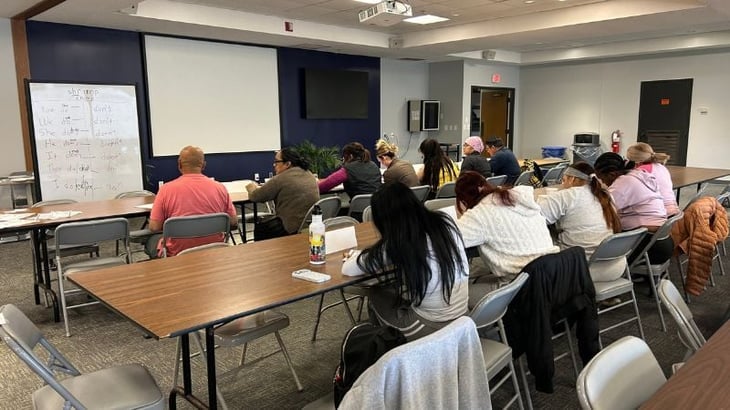
- After earning her TEFL certification, Diana taught workplace English to employees at a Tyson Foods plant, adapting lessons for adult learners with different English proficiency levels.
- Diana recommends gaining hands-on teaching experience while completing your TEFL course, both to put what you’re learning into practice and to explore where TEFL might take you.
An Alum’s Journey in Teaching Corporate ESL
For many International TEFL Academy (ITA) students, earning a TEFL certification is the first step toward an adventure abroad. However, a TEFL certification can also open doors closer to home and sometimes in places you might not expect.
For ITA alum Diana Guest, that opportunity came during an unexpected career transition. After nearly 40 years in occupational therapy, including several years teaching occupational therapy students, Diana began considering what she wanted the next chapter of her career to look like.
Her search and life ultimately led her to teaching English as a second language. Diana enrolled in ITA’s 11-week Online TEFL Course in April 2026 and, not long after, found an opportunity to use her certification without moving abroad.
We caught up with Diana to talk about how she discovered TEFL, navigated a career transition, and how her certification led to an unexpected opportunity.
This conversation has been edited for length and clarity.
Transitioning to a TEFL Career
What led you to pursue a TEFL certification?
I was an occupational therapist for almost 40 years. Toward the latter part of my career, I spent about five years teaching academically, teaching occupational therapy assistants.

When I moved back to Michigan, I had a difficult time finding that same kind of work. I ultimately found another position, but at the beginning of this year, I became unemployed.
I had never been unemployed before. It was a very humbling and, in some ways, humiliating experience. It made me really start thinking about where I wanted to go with my career and what I wanted to do next.
I was spending all day literally on the computer just trying to figure out my life, and then I kept running into teaching English as a second language. I thought you needed a college degree for that, but you don't; you can get TEFL certified and still do it.
That got me thinking about what I really enjoyed and what I felt were my strengths. One thing I kept coming back to was teaching. I really enjoyed it, and I thought, well, if I wanted to pursue that, why not get my feet wet by volunteering?
Then my phone's algorithm suggested a wonderful website called ENGin, which matches you with a Ukrainian for conversation so you can volunteer to offer conversational English. And I thought, well, that's really interesting. And when I got on their website back in late February or March, they even had a program where they were matching educators with Ukrainian educators for conversational English. So I applied, and within three days, they matched me with a Ukrainian professor.
How did that experience lead to getting TEFL certified with ITA?
I found out I could use those hours for the teaching practicum. So, kind of through a back door, without realizing it, the stars aligned for me. I'm like, "Wow, I've already got teaching practicum hours that I know I can count because you can count back six months from the time of your course, to include those hours." So I did.
What made you decide to get TEFL certified with ITA?
I was on the fence about doing it part-time or full-time. I could do it full-time, but I ultimately chose the 11-week course. At that point, I was very interested in getting my Teaching English as a Second Language certification, and I was convinced ITA was the program that would best suit my needs. I was aiming for the 170 hours, which I thought was totally legitimate compared to other programs. And I saw there were over 50,000 alumni. So it made a lot of sense for me just to go down that path.
You also started teaching experience while you were completing your TEFL course. What was that experience like?
I also pursued another face-to-face teaching practicum, which turned out to be a wonderful, free ESL program for adult immigrants in Grand Rapids. It was offered at Church of the Servant, where immigrants and recent immigrants from Grand Rapids come for free ESL classes.
Once I got there, I thought I was just going to observe, but by the second week they already needed a substitute teacher. So one week would be one class, and another week would be another class. I already had teaching experience from my occupational therapy background, so that wasn't a problem for me. Now I'm just applying what I was learning in my course. It really worked well for me. I know a lot of people wait to do their teaching practicum hours after the course, but I would totally advocate doing it at the same time, or starting the class and, partway in, applying the knowledge right away because it just meshes and makes a lot of sense.
By the time my 11-week course ended, I had more than enough teaching practicum hours, and I was also continuing to volunteer with my wonderful Ukrainian friend, and I'm still doing so weekly.
Teaching English at Tyson Foods
Since 2016, Tyson Foods has supported its frontline workers through the Upward Academy program, which offers free classes in ESL, GED prep, citizenship, and financial and digital literacy. To build on this, Tyson partnered with the social impact platform Guild in 2022, expanding Upward Academy's reach to give employees access to more than 175 tuition-free educational programs.
How did you find the opportunity to teach English at Tyson Foods?
I was looking for online work. I applied to a place based in Singapore. I thought I had a good shot because I have five years of academic teaching experience, but I didn't have one year of teaching English as a second language, which was one of their criteria, so I was eliminated.
By then, I had already refined my resume. I also refined my LinkedIn profile, and I seem to recall that a recruiter might have connected me with this company [Tyson Foods], which was looking for an ESL instructor on LinkedIn. I was a little skeptical at first. I've had to be very careful when applying for overseas positions online because many positions aren't legitimate. So I treated it very carefully. I even called Tyson Foods headquarters to verify that the position was real, and it was.
So that's where I continued to proceed, and perhaps I was a little surprised that I was asked for an interview, and I knew I was one of, I don't know how many, candidates, but I seemed to go through all the hoops one after the other, and here I am. I just finished three weeks of part-time teaching with Tyson Foods.
I never thought Tyson Foods even hired ESL people. They have over 100 plants in the country; in about 40 of them, they have ESL instructors.
What does a typical day look like?
Tyson Foods is amazing. They already have an established curriculum that was established, I think, partially by somebody who already had a linguistics or ESL master's degree. They have an amazing orientation program. They incorporate a lot of tools, but Tyson Foods really emphasizes teaching English and applying it to workplace knowledge and speaking. So, a typical day for me would be: I can go into the curriculum, I find the lesson, and they've got a whole file on what needs to be printed.
I figure out how much needs to be printed. I've got this wonderful classroom space. The plant that I'm going to is 600,000 square feet.
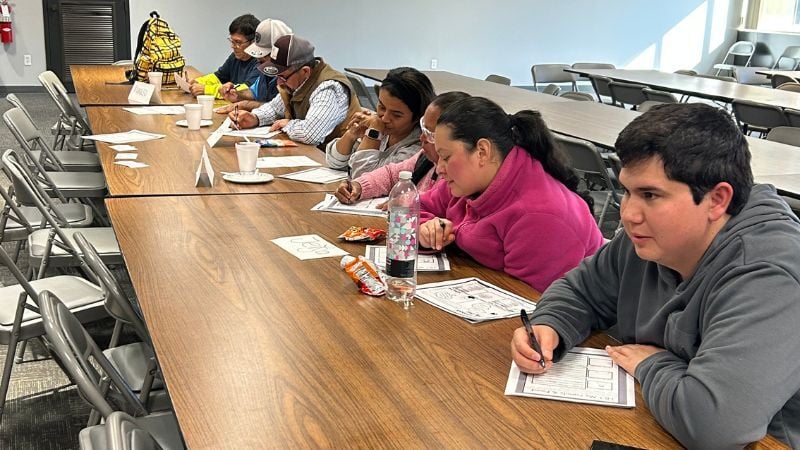
I have three classes that meet twice a week, between 1 and 5:30 pm. I have a 1:00 pm class, a 2:30 pm class, and a 4:00 pm class. Each class has different English proficiency levels, but we use this curriculum, and I can adapt it. We do a lot of games, flashcards, and worksheets, just trying to get in the groove of a lot of speaking.
I have to be flexible. Class doesn't start right at 1:00 pm. They're going to come dribbling in. So, I have music playing. I have food out. I have labeled all the food, and I've labeled which ones are plates and napkins. I'm interacting with them, saying, "Do you like a certain food?"
I have worksheets so they can just sit down, eat, drink, laugh, and work on their worksheet. And then, as more people come into the class, I'll say, " Welcome, " and this is, you know, today's games.
On the other days, behind the scenes, I might take attendance, review the curriculum, email, check the needs assessment scores, and things like that. So I'm thankful for the flexibility of not teaching every single day. I have a little breathing space in between classes to prepare.

What kind of lessons are you teaching and how do you adapt them for different proficiency levels?
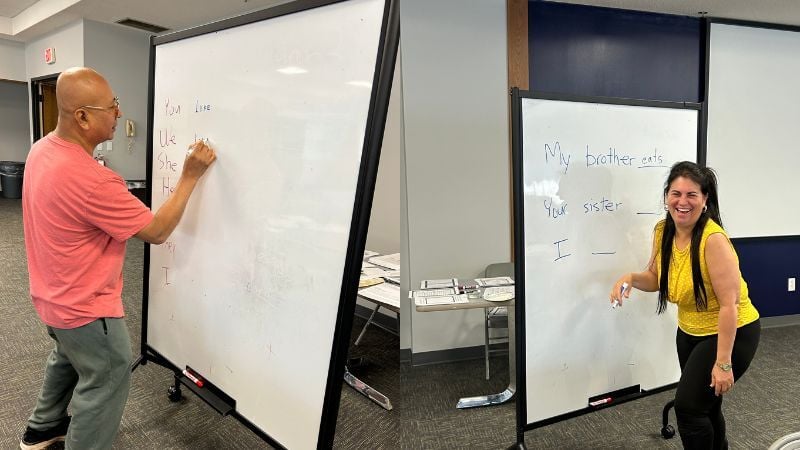
I've had to really adapt back to that A1 level. I can't even play hard games with them because they won't know the directions. We've played ball: throw it across the room, say something, and throw it back. I've had them run across the room, write something on the whiteboard, and come back. I'll break them into groups and into pairs. I know this was all part of my ITA training, but it works so effectively. Just keep teaching speaking. So they're teaching each other the flashcards, and then some of them will ask me a more complex question if they have a little more English.
What is the background of your students?
From what I've observed, the youngest in my class could easily be in their early 20s and work as a machine operator at Tyson Foods. I've had, and I still have, students in the class who say they've been with Tyson Foods for 25 to 26 years. Spanish is their first language, and they're coming from Central America, South America, Cuba, and Puerto Rico. They're all there on their own time. They aren't getting paid to be there, but Tyson Foods does have an incentive program for them. They know they're there to learn their English.
Were there any skills, lessons, or resources from your TEFL course that you found yourself applying in this role?
I think what I've really applied is just so much speaking and then breaking it down. I think the kinesthetic part is really important because it adds another layer of buoyancy to the environment. These are adult English learners, too. I don't want them coloring an apple and learning that it's red. I need them just to be treated like adults.
Breaking down the English and doing the needs assessment are important, too. I can recognize their needs and remember, it's not about accuracy; it's about fluency. I don't have to correct every grammatical mistake. It is about giving them the words and reinforcing that.
Making an Impact Through Teaching
What have you enjoyed most about teaching at Tyson Foods?
I enjoy the face-to-face class dynamic. I feel professional and respected, and it's also great to build rapport and be part of a team.
I know I'm a contract member, and this position was newly created for that plant. So, I am kind of planting a seed for them, and depending on how this goes, they're going to offer the class again in January.
One student shared with me, and it really hit my heart. She's only been with Tyson Foods for three months, but I asked her, "What does your future look like?" She said, "I want to be here so that I can move up the ladder. I want to become a team leader, and someday I want to own my own online company." And here she's speaking as a second-language speaker, but honestly, she's so motivated. She's going to go places. These are people who are going to go places.
What advice would you give to someone considering a similar path into TEFL and teaching English?
I was on a learning curve. I hadn't been on LinkedIn before all of this, and I was experiencing everything for the first time. So I would say to look into that, and I would also encourage anyone out there to look at that ENGin website.
It's a nonprofit. It's free. As a volunteer, you get experience. It can help you decide whether you even want to pursue this teaching English as a second language certification, and if you do, you already have hours, so you're not scrambling at the very end just to figure that out or find a place to get your hours. It's well worth it to pursue that. And I can't say enough good things about the ENGin website. They're doing an amazing job with students of all ages. The site has children and adults, and you can choose whether you want to work with someone with more advanced or less advanced English.
It's just a great opportunity, and we're helping the Ukrainian people, so it's really cool.
Looking back on your experience so far, what has been the most meaningful to you?
I think what really just gives me so much excitement and so much satisfaction is knowing I'm playing that little small role that's planting a seed in someone. I'm towards the end of my career. I could keep working as long as I want. It doesn't matter. But there are other people out there who are mid-career or younger. And who knows where that seed will grow. I think we're planting so many seeds not only of that English, but also helping them in their careers and making this world a better place.
These are the things we can control. You know, so much is out of our control, but if we're planting those seeds and just helping one person at a time, we're all making this a better place for everyone.
Explore Your Own Path With TEFL
Posted In: TEFL Certification, TEFL

Want to Learn More About Teaching English Abroad & Online?
Request a free brochure or call 773-634-9900 to speak with an expert advisor about all aspects of TEFL certification and teaching English abroad or online, including the hiring process, salaries, visas, TEFL class options, job placement assistance and more.